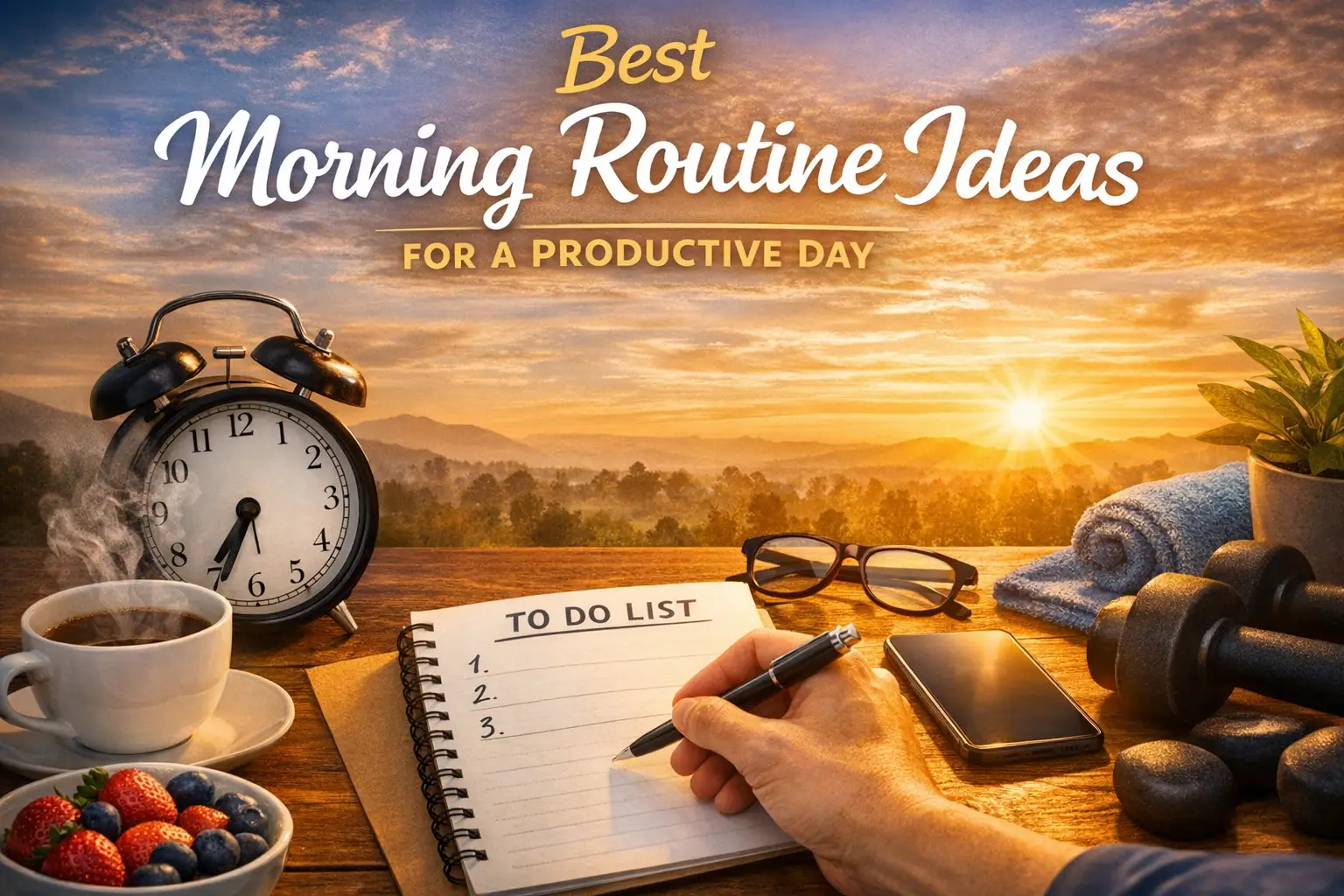
Your morning is the “remote control” for the rest of your day. If you wake up rushed, reacting to frantic notifications and skipped alarms, your productivity will likely plummet by noon. However, when you implement the best morning routine ideas, you gain the clarity, focus, and energy needed to tackle high-level challenges.
In this guide, we will break down the science-backed productive morning habits that successful people use to stay ahead. Whether you are a night owl trying to pivot or a high-achiever looking to optimize, these strategies will show you exactly how to start your day productively.
The Path to Mastery: Designing Your High-Performance Morning
Your mornings are the foundation of your future. By applying these best morning routine ideas for a productive day, you aren’t just checking boxes or following a trendy checklist—you are intentionally designing a life of purpose. In a world that thrives on your distraction, a structured morning is the ultimate competitive advantage. It is the bridge between a life that “happens to you” and a life that is “created by you.”
Remember: Consistency beats intensity every single time. You don’t need to transform into a 4:00 AM marathon runner overnight to see results. Success is found in the compounding interest of small, daily actions. If you start with just two habits tomorrow—perhaps hydrating and identifying your top priority—you will begin to see a shift in your mental clarity. Over weeks and months, these micro-wins coalesce into a formidable sense of self-discipline.
Scaling Your Routine for Long-Term Success
As you become more comfortable with your morning structure, you can begin to layer in more advanced strategies to further optimize your output:
The Weekly Review: Every Sunday, look back at your morning wins. What habit made the biggest impact on your mood? Which one felt like a chore? Refine your routine like a scientist conducting an experiment.
The “Deep Work” Block: Dedicate the first 90 minutes of your workday to your most cognitively demanding task before checking a single email. This is when your brain’s $prefrontal \space cortex$ is at its peak operating capacity.
Active Recovery: On weekends, swap intense exercise for long walks or mindfulness practices to prevent burnout while maintaining your wake-up momentum.
1. Start with “Negative Prep” the Night Before
A successful morning doesn’t actually start when you wake up—it starts the night before. Decision fatigue is a real productivity killer. By making small decisions in advance, you save your “mental battery” for important work.
- Lay out your clothes: Eliminate the “What should I wear?” internal debate.
- Set a “Why”: Write down one exciting reason to get out of bed.
- Prep your space: Clean your desk or kitchen counter so you wake up to order, not chaos.
2. The “No-Phone” Golden Hour
Checking social media or email the second you wake up forces your brain into a “reactive” mode. You are immediately responding to other people’s needs, news, and stressors.
To maintain a healthy morning routine, avoid your phone for at least the first 30 to 60 minutes. This creates a “sacred window” for self-reflection and deep thought, which significantly reduces morning anxiety and boosts long-term concentration.
3. Hydrate to Activate Your Brain

After 7–8 hours of sleep, your body is naturally dehydrated. Dehydration leads to “brain fog,” which many people mistake for lack of sleep.
Pro Tip: Keep a 16 oz glass of water by your bedside. Drinking it immediately upon waking jumpstarts your metabolism and flushes out toxins, making it one of the simplest yet most effective daily habits for success.
4. Utilize Movement to Spike Cortisol Naturally
You don’t need a grueling 2-hour gym session to see results. Light movement signals to your circadian rhythm that the day has begun.
- Stretching: Releases muscle tension from sleep.
- Quick Walk: Exposure to natural sunlight helps regulate your sleep-wake cycle.
- Bodyweight Exercises: 10 minutes of air squats or push-ups increases blood flow to the brain, enhancing cognitive function.
5. Master the “Rule of Three” for Goal Setting
A common mistake in any morning routine checklist is trying to do too much. Instead of a 20-item to-do list, identify your top three priorities.
Ask yourself, “If I only got three things done today, which ones would make me feel the most accomplished?” By narrowing your focus, you prevent multitasking and ensure that your energy goes toward meaningful progress rather than “busy work.”
6. Feed Your Mind with “Input” Learning
Successful people’s morning routine habits almost always include a period of learning. This stimulates the prefrontal cortex and gets your creative juices flowing.
- Read 10 pages of a nonfiction book.
- Listen to a podcast while getting dressed.
- Journaling: Use “Morning Pages” (writing three pages of stream-of-consciousness thought) to clear mental clutter.
7. Strategic Nutrition: Fuel, Don’t Crash
If your breakfast is heavy in refined sugars (like pastries or sugary cereals), you’ll experience an insulin spike followed by a mid-morning crash. A productive morning routine should include a balanced meal:
- Proteins: Eggs, Greek yogurt, or protein shakes.
- Healthy Fats: Avocado or nuts for sustained brain fuel.
- Fiber: Berries or oatmeal to keep you full longer.
8. Eat the Frog: Start with Your Hardest Task
Coined by Mark Twain, “eating the frog” means doing your most dreaded or difficult task first. When you tackle your most important task (MIT) early, you build a “win” that creates massive momentum. This eliminates the “dark cloud” of procrastination that usually hangs over your head all day.
Comparison: Reactive vs. Proactive Mornings
| Feature | Reactive Morning (Low Productivity) | Proactive Morning (High Productivity) |
| First Action | Checking Phone/Emails | Hydration & Movement |
| Mental State | Stressed & Distracted | Calm & Intentional |
| Breakfast | Sugary snack or skipped | Protein & Healthy Fats |
| Work Style | Tackling small, easy tasks | “Eating the Frog” (MIT) |
Real-Life Transformation: From Chaos to Clarity
I used to believe that “sleeping in” was the best way to recharge. I would wake up at 8:45 AM for a 9:00 AM job, feeling frantic and behind.
By shifting to a structured morning routine—waking up at 7:00 AM, journaling for 10 minutes, and exercising for 15—my output doubled. I stopped feeling like I was “surviving” the day and started feeling like I was “leading” it. Small morning motivation tips like these aren’t just about work; they’re about reclaiming your personal time.
Frequently Asked Questions (FAQs)
1. What are the best morning routine ideas for a productive day?
The most effective ideas include hydrating immediately, avoiding digital distractions for 60 minutes, practicing light physical movement, and identifying your top three priorities for the day.
2. How can I start my day productively if I’m not a “morning person”?
Start small. Don’t try to change everything at once. Pick one habit, like drinking water or stretching for five minutes, and do it consistently for a week before adding more.
3. How long should a healthy morning routine be?
It doesn’t have to be long. A “Power Morning” can be as short as 15–20 minutes. The key is the quality of the habits, not the duration.
4. Why is a morning routine important for success in 2026?
In an era of constant digital noise and remote work, a routine provides the mental “anchor” needed to stay disciplined and focused amidst distractions.
Final Thoughts on Morning Mastery
The goal of a morning routine isn’t to turn you into a robot; it’s to automate the mundane so you have the mental energy for the extraordinary. When you control your morning, you control the narrative of your day. You stop being a passenger in your own life and start being the architect of your destiny.
Don’t wait for the “perfect” Monday or a New Year’s resolution. The best time to reclaim your time was yesterday; the second-best time is the moment you wake up tomorrow. Start small, stay disciplined, and watch as your focus, energy, and overall quality of life transform beyond what you thought possible.