
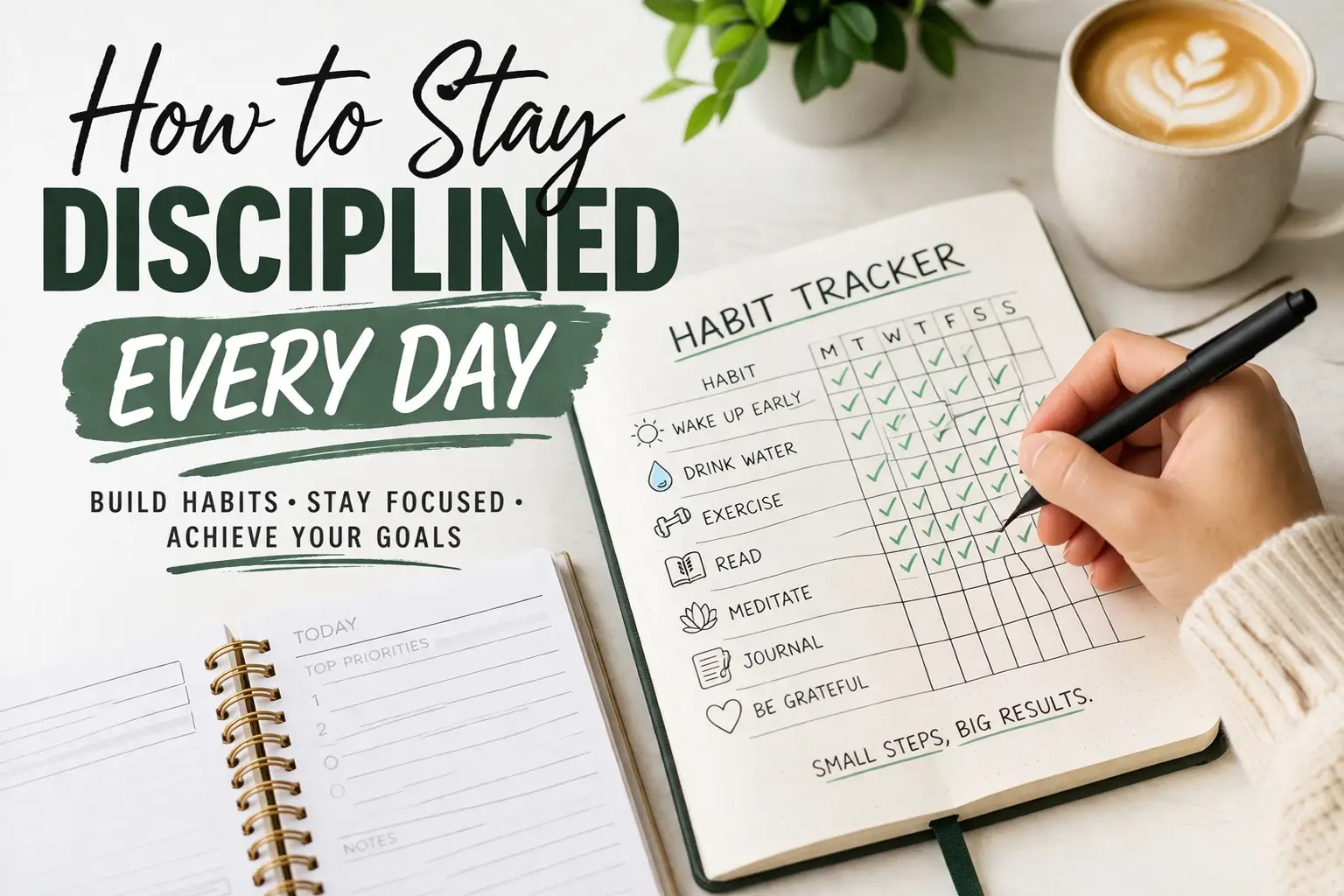
If you’ve ever Googled “how to stay disciplined every day,” you already know the feeling you start the week fired up, you have a plan, maybe even a brand-new journal, and by Wednesday it’s all fallen apart. The gym session didn’t happen. The to-do list sat untouched. And you’re back to wondering what’s wrong with you.
Here’s the truth: nothing is wrong with you. Discipline isn’t a personality trait that some people are born with and others aren’t. It’s a skill and like any skill, it can be learned, practiced, and built into your life one small habit at a time.
This guide breaks down exactly why discipline is so hard to maintain, what most people get wrong about it, and the real, practical daily discipline habits that finally make it stick no motivational speeches required.
What Discipline Actually Means (It’s Not What You Think)
Most people picture discipline as forcing yourself through pain waking up at 5 a.m., grinding through workouts you hate, and never enjoying anything. That picture is wrong, and it’s actually one of the main reasons people fail to build it.
Real discipline is simply the ability to do what you said you would do, even when you don’t feel like it. It’s not about being a machine. It’s about building systems that make the right behavior easier to repeat than to avoid. When those systems are in place, discipline starts to feel almost automatic not like a constant battle with yourself.
📊 Research from University College London found that it takes an average of 66 days not 21 for a new behavior to become truly automatic. The good news? The first few repetitions are the hardest. After that, it genuinely gets easier.
Understanding this changes everything. You’re not trying to white-knuckle your way through every single day. You’re trying to repeat behaviors long enough that they stop requiring willpower at all.
Why Staying Disciplined Every Day Feels So Hard
You’re not lazy. You’re not weak. But your brain is working against you in ways that most self-help content completely ignores. Here are the real reasons consistency feels so difficult:
Your Brain Is Wired to Seek Comfort, Not Growth
The prefrontal cortex the part of your brain responsible for long-term thinking and self-control burns a lot of energy. When you’re tired, stressed, or emotionally drained, your brain defaults to the easier, more comfortable option every single time. This is called ego depletion, and it’s why your discipline seems to collapse in the evening or after a hard day at work.
This is also why willpower alone is never enough. It’s a limited resource, and you will run out of it. The goal is to design your life so that you need to use as little willpower as possible.
You’re Relying on Motivation Instead of Systems
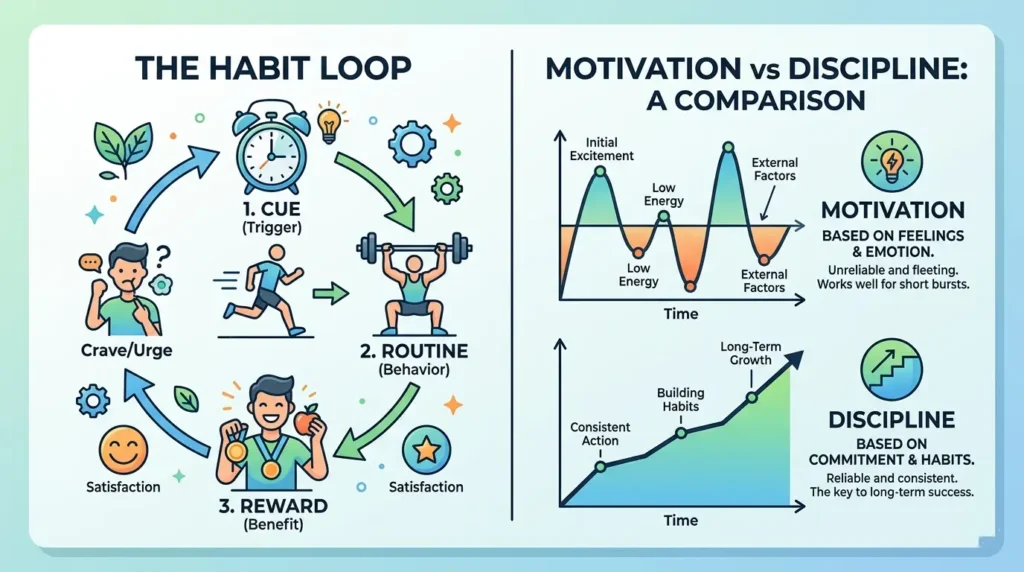
Motivation is an emotion. It shows up when it feels like it and disappears when things get hard. If your daily discipline depends on feeling motivated, you’re always one bad mood away from quitting. The people who stay disciplined every day aren’t more motivated than you they’ve simply built routines and environments that don’t rely on how they feel in the moment.
Your Goals Are Too Big and Too Vague
“Get fit.” “Be more productive.” “Stop procrastinating.” These goals feel meaningful but they give your brain no clear action to take. Vague goals produce vague behavior. When you don’t know exactly what to do next, your brain fills that gap with the path of least resistance usually your phone, the couch, or something else that wasn’t on the plan.
The Real Causes of a Lack of Self-Discipline
Before you can fix something, you have to understand what’s actually breaking it. A lack of self-discipline almost always comes from one or more of these root causes:
- Poor sleep — Sleep deprivation directly weakens the prefrontal cortex, the exact region that controls impulse and focus. One bad night can cut your self-control in half.
- No clear identity — People who say “I’m trying to exercise more” fail far more often than those who say “I’m someone who works out.” Your behavior follows your self-image, not your goal list.
- An environment full of temptation — If your phone is always within reach, your fridge is full of junk food, and Netflix autoplays the next episode, you’re fighting your environment every hour of the day. Discipline is exhausting when your surroundings work against you.
- No accountability — When no one knows your goals, there are no consequences for quitting. Accountability — whether from a friend, a coach, or a public commitment — dramatically improves follow-through.
- Perfectionism — Many people abandon a habit entirely after one missed day because they believe anything less than perfect doesn’t count. This “all or nothing” mindset is one of the biggest discipline killers there is.
- Emotional triggers and stress — Chronic stress floods the brain with cortisol, which impairs the very decision-making and focus you need to stay on track. Emotional regulation and daily discipline are more connected than most people realize.
⚠️ Important: If your lack of discipline is accompanied by persistent low energy, inability to focus, or a general sense of hopelessness, it may be worth speaking with a doctor. These can be signs of depression, thyroid issues, or burnout all of which are treatable and all of which make self-discipline significantly harder.
Daily Discipline Habits That Actually Work
These aren’t life hacks or motivational tricks. These are evidence-backed behaviors that consistently show up in the routines of disciplined people across every walk of life.

1. Start With a Non-Negotiable Morning Anchor
Every disciplined day starts with one simple action you do without exception no matter how you feel. It doesn’t have to be dramatic. It could be making your bed, drinking a glass of water, or doing five minutes of stretching. The point is that completing something intentional the moment your day starts puts you in the mindset of a person who follows through.
Small wins early in the day build momentum that carries into everything else. Psychologists call this behavioral activation action creates motivation, not the other way around.
2. Use the “Two-Minute Rule” to Destroy Procrastination
If a task takes less than two minutes, do it immediately. If a habit feels too big to start, shrink it down until it takes two minutes. Want to read more? Open the book and read one page. Want to exercise? Put on your shoes and walk to the door. The point isn’t the two minutes — the point is that starting is the hardest part, and this rule removes the barrier to starting.
3. Design Your Environment Before You Need Willpower
Put your gym bag by the door the night before. Keep a glass of water on your desk. Put your phone in another room during focused work hours. Charge it in the kitchen, not your bedroom. Every environmental cue you set up in advance is one less decision you have to make and fewer decisions means more mental energy left for what actually matters.
4. Track Your Habits Visibly
A simple paper calendar where you cross off each day you completed your habit creates what James Clear, author of Atomic Habits, calls a “chain.” The psychological drive to “not break the chain” becomes a powerful motivator in itself. You stop doing the habit for the goal and start doing it to protect your streak which is often more immediately compelling.
5. Plan for Failure Before It Happens
Ask yourself: “What’s the most likely reason I’ll skip this tomorrow?” Then solve that problem today. Rain forecast? Move your workout indoors. Know you’ll be tired after work? Schedule it for the morning. This technique called implementation intention has been shown in multiple studies to more than double the likelihood of following through on a goal.
6. Protect Your Sleep Like It’s a Non-Negotiable
Every hour of sleep you sacrifice costs you far more than the extra time feels worth. Sleep is when your prefrontal cortex recovers — it’s when your self-control literally recharges. Disciplined people aren’t just disciplined about their goals; they’re disciplined about their bedtime first.
How to Build a Discipline Routine That Lasts
A routine is the infrastructure that makes daily discipline possible without exhausting yourself. Here is a simple framework you can set up this week:
- Pick one habit to anchor everything to. Not five. One. Usually your morning routine is the best place to start because it sets the tone for the whole day before the world can interrupt you.
- Stack new habits onto existing ones. This is called habit stacking. “After I pour my morning coffee, I will journal for five minutes.” The existing habit becomes the trigger for the new one.
- Make the reward immediate. Your brain learns through immediate feedback. If the only reward for your discipline is a vague future goal (“I’ll be healthier someday”), your brain won’t care enough. Build in small, immediate rewards a favorite podcast during your workout, a good coffee after a focused work session, ten minutes of something you enjoy after completing your most dreaded task.
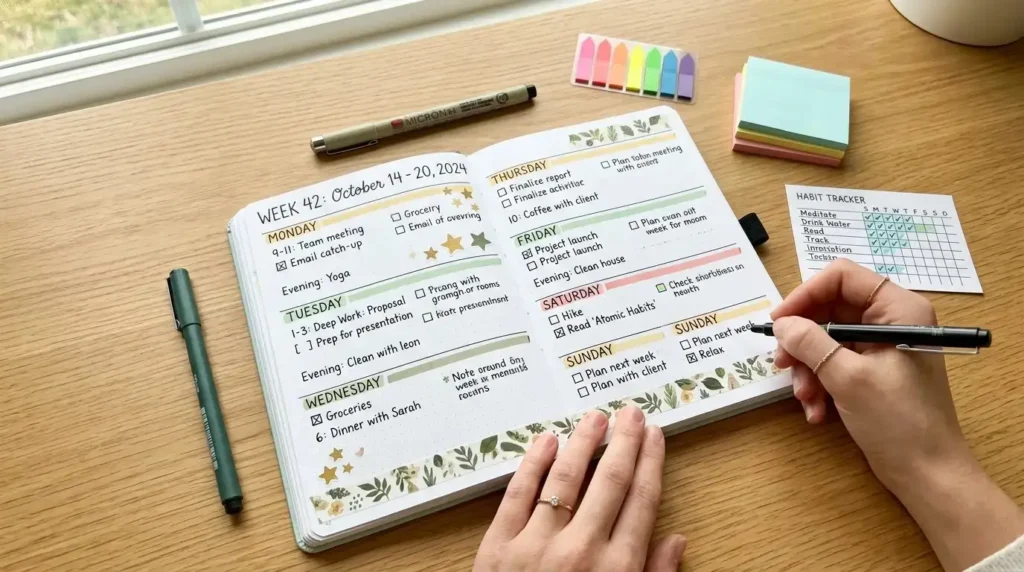
- Review your week every Sunday. A five-minute weekly check-in asking “What worked? What got skipped? What do I want to change?” gives you self-awareness that compounds over time. Most people fail the same way every week without ever noticing the pattern because they never stop to look.
For a more detailed breakdown of how to structure your morning for maximum focus and follow-through, read our guide on the Best Morning Routine Ideas for a Productive Day. And if you want to understand how self-belief connects to daily action, our piece on 12 Proven Confidence-Building Techniques is a natural next read.
Discipline vs Motivation: Which One Do You Actually Need?
This is probably the most important section in this entire article, so read it slowly.
Motivation gets you started. Discipline keeps you going. Motivation is the spark exciting, emotional, and completely unreliable. Discipline is the engine steady, boring, and the only thing that actually produces results over time.
The problem is that most people wait to feel motivated before they act. They say, “I’ll start when I feel ready.” But readiness is a feeling, and feelings change. The disciplined approach is the opposite: you act first, and the feeling follows. Show up to the gym without enthusiasm and nine times out of ten, you’ll be glad you went. Open the laptop and start working even when you don’t want to, and focus usually arrives within ten minutes.
📊 A 2021 study published in the British Journal of Health Psychology found that people who made specific plans for when, where, and how they would act on a goal were two to three times more likely to follow through regardless of how motivated they felt at the time. The plan mattered far more than the mood.
So stop waiting to feel like it. Make the plan, set the trigger, and start anyway. The motivation will catch up.
For deeper reading on the psychology of self-control and how it connects to long-term wellbeing, Psychology Today’s guide on Self-Control is an excellent resource. The American Psychological Association’s research on Willpower also explains why relying on willpower alone consistently fails and what actually works instead.
Frequently Asked Questions
Q1: How to stay disciplined every day when you have no motivation?
Stop waiting for motivation it almost never shows up on demand. Instead, focus on your system. Set a specific time, place, and trigger for your habit, and commit to showing up for just two minutes. Action creates motivation, not the other way around. Once you start, continuing almost always feels easier than you expected.
Q2: What are the best daily discipline habits to start with?
Start with just one ideally something tied to your morning. Making your bed, journaling for five minutes, or a short walk are all excellent anchors. The habit itself matters less than the fact that you’re building the identity of someone who follows through. Stack more habits once the first one feels effortless.
Q3: How long does it take to build self-discipline?
University College London research suggests that new behaviors become automatic in about 66 days on average, though it varies by person and habit complexity. The first two weeks are the hardest. After a month, most people report the habit feeling significantly more natural. After 66 days, it usually requires very little conscious effort.
Q4: What causes a lack of self-discipline?
The most common causes are poor sleep, vague goals, an environment full of distractions, no accountability, perfectionism, and chronic stress. Most people try to fix lack of discipline with more willpower but the real fix is changing your environment and your systems so you need less willpower in the first place.
Q5: Is self-control and mental strength the same thing as discipline?
They’re closely related but slightly different. Self-control is the ability to resist impulses in the moment. Mental strength is the broader capacity to stay focused and resilient under pressure. Discipline is the daily practice that builds both over time. Think of discipline as the habit, and self-control and mental strength as the muscles it develops.
Q6: What should I do when I break my discipline streak?
Missing one day is normal and fine research consistently shows it doesn’t significantly affect long-term habit formation. What matters is never missing twice in a row. The moment you miss two consecutive days, you’re no longer recovering from a slip you’re starting a new habit of not doing it. Get back on track the very next day, without guilt, without drama.
Conclusion
Now you know exactly how to stay disciplined every day and more importantly, you understand why your past attempts may not have worked. It was never about lacking willpower or being the wrong kind of person. It was about using the wrong strategy.
Discipline is not something you either have or don’t have. It’s something you build one small decision at a time, repeated often enough that it eventually stops feeling like a decision at all. The key is to start small, design your environment to support you, stop waiting to feel ready, and show up even on the days it doesn’t feel worth it because those are actually the days that matter most.
Pick one habit from this article. Just one. Commit to it for the next seven days. See what happens. That first week of consistency is worth more than a hundred motivational quotes.
Your Discipline Starts Today, Not Tomorrow
Choose one habit from this list and commit to it for just seven days. Leave a comment below with the habit you’re starting accountability begins the moment you say it out loud. 💪